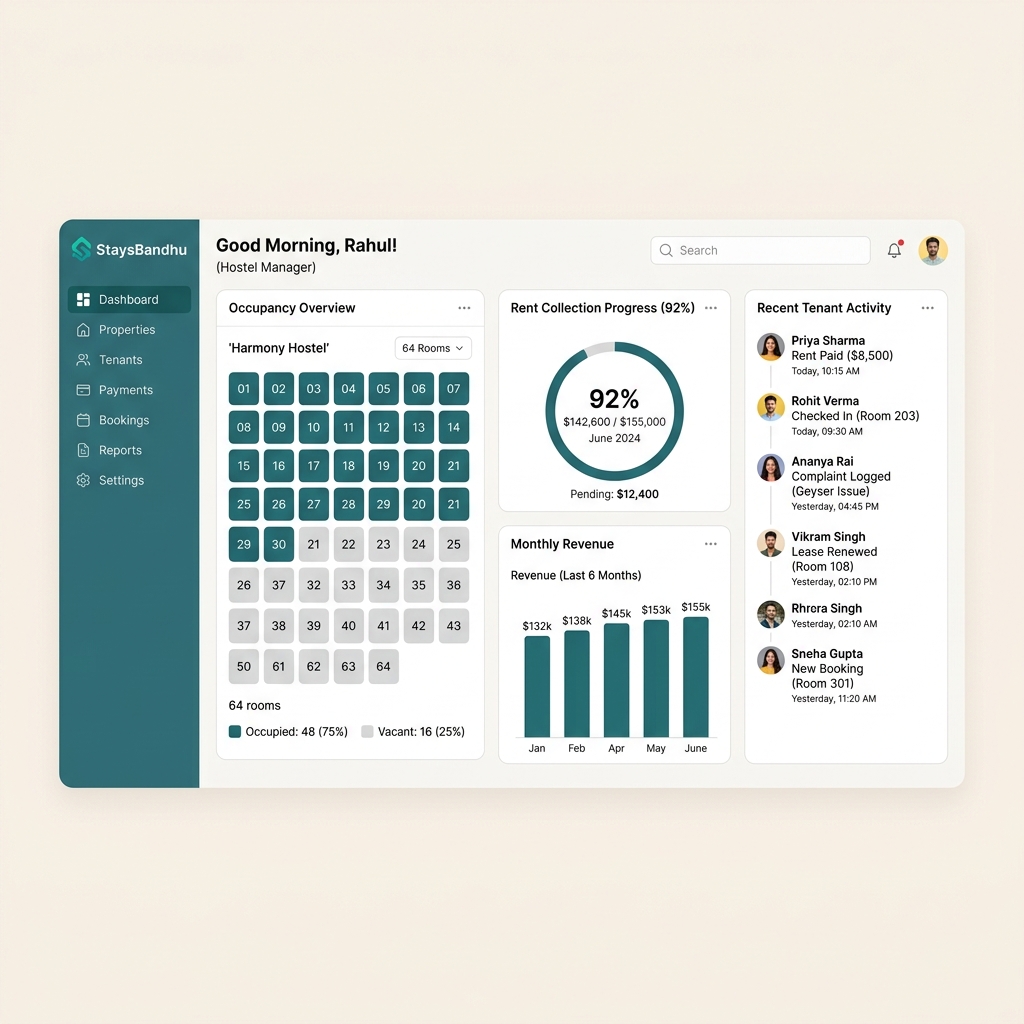
Spend a morning with almost any PG or hostel owner in an Indian city and the operating system reveals itself quickly: a WhatsApp group for announcements, a notebook or Excel sheet for who owes what, a stack of tenant ID photocopies in a drawer, and a phone that never stops buzzing with maintenance complaints. It holds together at 10 beds. At 40, it starts to crack. At 80, it quietly bleeds money.
A Booming Market Run on Manual Tools
The demand side has never looked better. India's co-living market is projected to grow roughly fivefold — from about ₹40 billion in 2025 to ₹206 billion by 2030 — driven by students and a young workforce moving to cities for education and jobs. With an estimated 150 million internal migrant workers making up close to a third of the workforce, the people who need managed accommodation aren't slowing down.
Yet the supply side — the owners actually housing these tenants — is still running on tools designed for a five-tenant side hustle. The gap between a market scaling into the hundreds of billions and operators managing it by hand is exactly where the pain lives.
The Real Cost of 'Chasing' Rent
Rent collection is the clearest example. On paper, occupancy looks healthy. In practice, money arrives across UPI, cash, and bank transfers, on different days, from different people, with no single record tying it together. When the owner finally sits down to reconcile, they're cross-checking bank SMS, WhatsApp screenshots, and a notebook — and that's where leakage happens.
Most rent disputes aren't about tenants refusing to pay. They're about confusion — unclear records, missing receipts, and a payment that did happen but was never logged. The problem isn't dishonesty. It's the absence of a single source of truth.
This matters even more in India because UPI now accounts for roughly 85% of digital payments and processes over 20 billion transactions a month. Tenants have already gone digital. The owner collecting that money is often the only analog link in an otherwise digital chain — manually matching a UPI credit to a name and a room.
Where the Notebook Method Breaks
Rent is just the most visible failure. The same manual approach quietly breaks down across every part of the operation as a property grows:
- Empty beds go unnoticed — vacancies are a fixed cost with zero revenue, but no one tracks days-vacant per bed
- Tenant documents live in drawers and chat threads, making verification and police-mandated records slow and incomplete
- Complaints arrive by call and message with no ticket, no owner, and no record of whether they were resolved
- Onboarding a new tenant means re-collecting the same documents, agreements, and deposits from scratch every time
Each of these is survivable on its own. Stacked together, across two or three properties, they consume the owner's entire day — turning a business owner into a full-time data-entry clerk and debt collector.
Why Existing Software Hasn't Helped
It isn't that PG owners haven't tried. Many have looked at property management software and walked away. The tools were built for large residential complexes or commercial real estate — heavy, feature-dense, and priced for portfolios, not for an owner running 40 beds who just wants to know who hasn't paid this month.
The barrier to switching has never really been cost. It's effort. A system that demands hours of setup, configuration, and training competes directly with the owner's time — and loses to the notebook, which works today and needs no learning.
What 'Built for PG Owners' Actually Means
When we built StaysBandhu, we started from how owners already work rather than how software wants them to work. Rent reminders had to fire automatically and escalate on their own. Payments across UPI, cash, and transfer had to reconcile into one ledger without manual matching. Onboarding had to capture documents once and reuse them. And the whole thing had to run from a smartphone, because that's the only device most owners manage from.
The hard part wasn't the features — it was making them invisible. A PG owner shouldn't configure an escalation sequence; they should flip one switch and never think about late-payment follow-ups again. The complexity belongs in the backend, not on the owner's plate.
The Opportunity
The co-living wave in India is not a forecast — it's already arriving, bed by bed, city by city. The owners housing this demand are ready to run real businesses, not improvised ones. They don't need more dashboards or more features. They need the boring, essential things — rent, rooms, documents, complaints — to simply take care of themselves. Meet them there, and digitizing a PG stops feeling like a project and starts feeling like a relief.
You might also like

Why Indian Cafes Are Still Running on WhatsApp and Notebooks
Most cafe owners in India manage orders, inventory, and billing through a mix of WhatsApp groups, paper notebooks, and gut feel. Here's why that's costing them more than they think.
Read article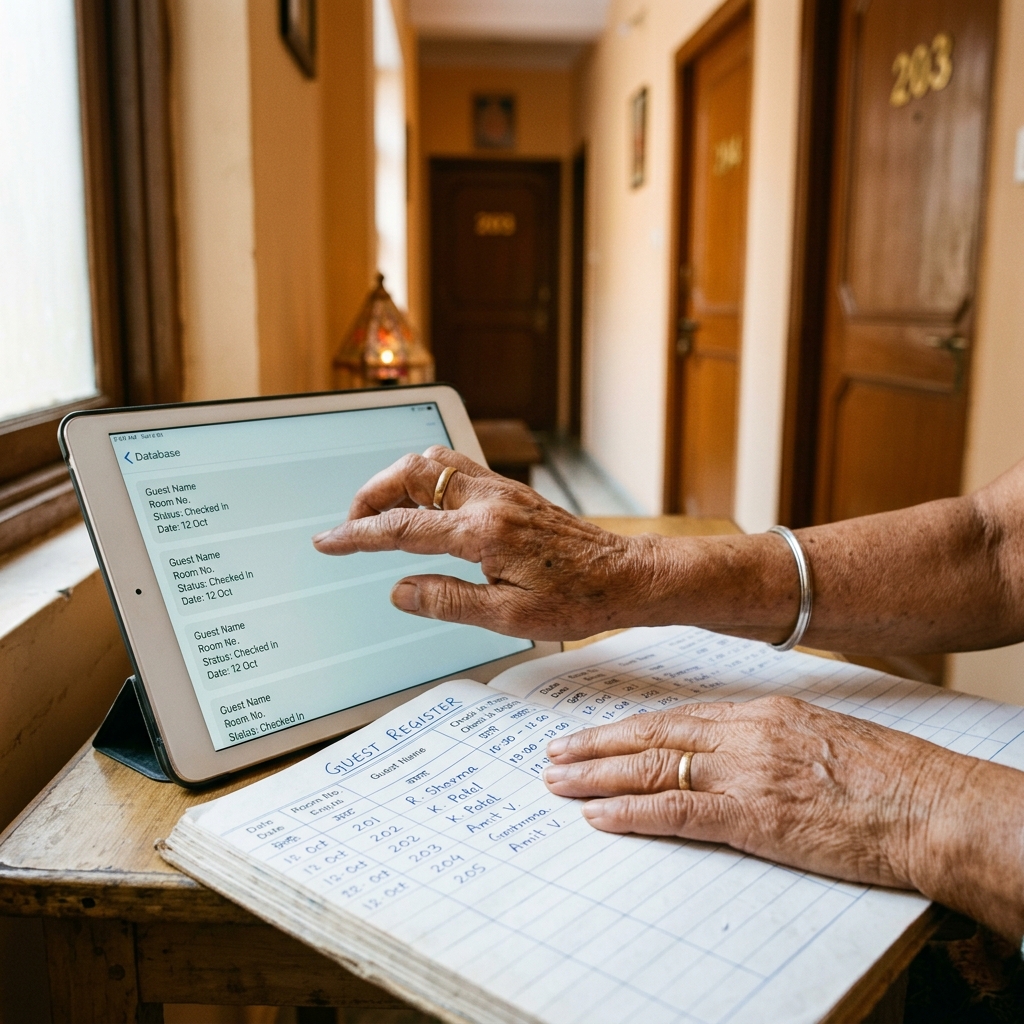
The Art of Building Software for Non-Technical Users
The hardest part of building software for urban businesses isn't the technology — it's designing systems that a 50-year-old PG owner can use without a manual.
Read article
Why We Run a Services Business and a Products Business at the Same Time
Most companies choose one: agency or product company. We chose both — intentionally. Here's the thinking behind Urbandhu's dual model and why it makes us better at both.
Read article